
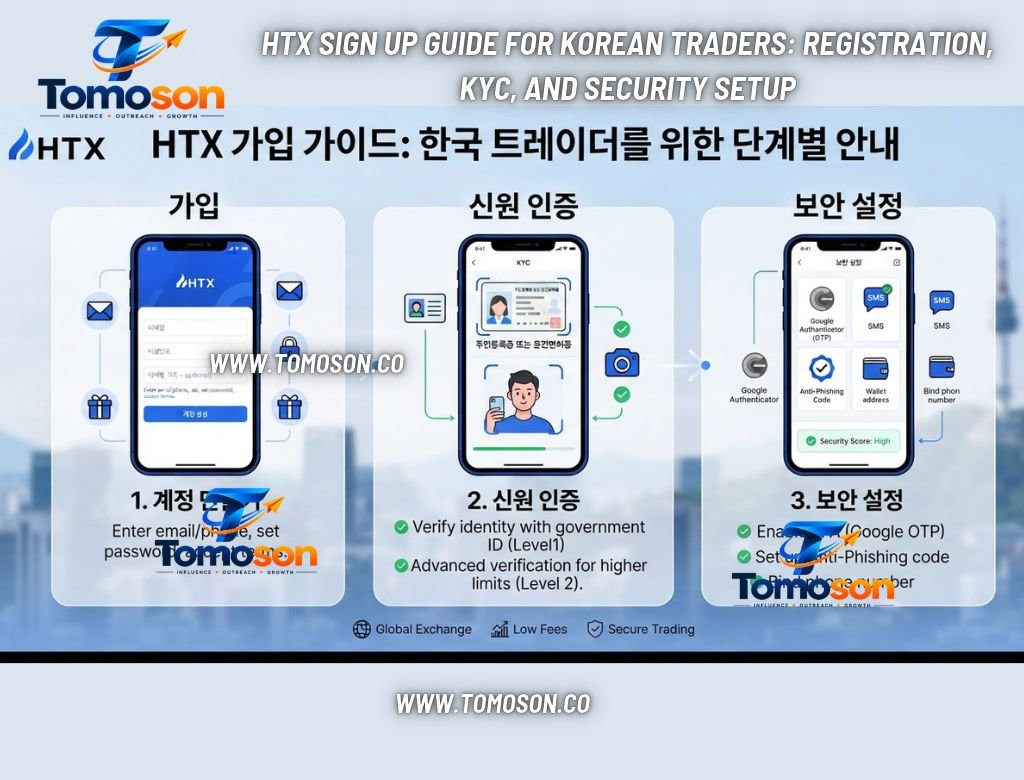
Interest in cryptocurrency trading and futures products keeps growing in South Korea. Many traders compare global platforms such as Binance, Bybit, and Huobi Global (now HTX) for lower fees, more trading pairs, and deeper futures liquidity. Before you trade on any platform, you need to register properly, verify your identity, and lock down your account. This guide walks through the full process for HTX.
Why Korean Traders Look at Global Exchanges
Domestic exchanges are heavily regulated and list a limited number of assets. Global platforms offer a wider range of tokens, perpetual futures, and margin products. Those products carry higher risk, and rules differ by jurisdiction. Before signing up, confirm that using an overseas exchange is permitted for you under current Korean regulations, and read the platform’s terms of service and restricted-region list.
Step 1: Create Your HTX Account
For a detailed walkthrough with screenshots, see the HTX 가입 방법 및 KYC 인증 가이드북 on Auseinet. The basic process looks like this:
- Open the official HTX website or app. Type the address yourself or use a trusted bookmark, because phishing clones are common.
- Choose to register with an email address or mobile number.
- Create a strong, unique password with uppercase and lowercase letters, numbers, and symbols. Don’t reuse a password from another service.
- Enter the verification code sent to your email or phone.
- Accept the terms and complete the sign-up.
If you have a referral code, enter it during registration. It may offer fee discounts or promotional rewards, but check the terms before relying on any bonus.
A quick note on referral codes: exchanges rely heavily on influencer marketing to attract new users, so many sign-up links you see on YouTube or social media are promotional. That isn’t a problem in itself, but treat any promised “guaranteed” bonus with skepticism and always confirm the offer on the exchange’s official site.
Step 2: Complete KYC Verification
KYC (Know Your Customer) verification confirms your identity and unlocks higher withdrawal limits and more features. Most exchanges use tiered verification:
- Basic verification: your name, nationality, and a government-issued ID such as a passport.
- Advanced verification: a facial liveness check and sometimes proof of address.
Tips for a smooth submission:
- Use a clear, uncropped photo of your original ID. Screenshots and photocopies are often rejected.
- Make sure the name on your ID matches the name you enter.
- Take your photo in good lighting, without glare or shadows over the text.
- Don’t use a VPN during verification, since mismatched location data can trigger a rejection.
Verification usually takes anywhere from a few minutes to a couple of days. If you are rejected, read the reason given and resubmit corrected documents rather than repeatedly trying the same files.
Step 3: Secure Your Account
Verification is only half the job. Security settings protect your funds if your password is ever exposed. After your first login, set up the following:
Two-factor authentication (2FA). Enable an authenticator app such as Google Authenticator. App-based codes are safer than SMS, which can be intercepted through SIM-swapping attacks. Store your backup key offline.
Anti-phishing code. Set a personal code that appears in every genuine email from the exchange. If a message doesn’t contain it, treat it as fake.
Withdrawal address allowlist. Restrict withdrawals to addresses you have pre-approved. Even if an attacker gets into your account, they can’t send funds elsewhere.
Funds password. Add a separate trading or funds password so a login alone isn’t enough to move assets.
Device and login management. Review your active sessions regularly and log out of devices you don’t recognize.
Step 4: Fund Your Account and Start Carefully
Once your account is verified and secured, you can deposit crypto from another wallet. Start with a small test transfer to confirm the network and address are correct before sending a larger amount. Crypto transfers are irreversible, and sending funds on the wrong network usually means losing them.
If you plan to trade spot markets first, get comfortable with limit and market orders before trying anything more complex.
A Word on Futures Trading
Futures and leveraged products let you open positions larger than your balance. That amplifies gains and losses equally, and many traders lose more than they expect. Keep these principles in mind:
- Use low leverage until you understand liquidation prices.
- Always set a stop-loss.
- Never risk money you can’t afford to lose.
- Understand funding rates, which can add up on positions held for days.
Choosing an Exchange You Can Trust
Every exchange works hard on its public image, and a polished site doesn’t prove an exchange is safe. Good brand marketing builds recognition, but it tells you nothing about custody practices or security record. Before depositing funds, look at how long the exchange has operated, whether it publishes proof of reserves, how it has handled past incidents, and whether it is transparent about regional restrictions.
Common Mistakes to Avoid
- Clicking links from social media or messaging apps. Scammers often impersonate support staff. Real exchange support will never ask for your password or 2FA code.
- Skipping 2FA because it feels inconvenient. Most account takeovers happen on accounts without it.
- Using the same email and password everywhere. One data breach elsewhere can expose your exchange account.
- Ignoring local rules. Tax and reporting obligations apply to crypto profits, so keep records of your trades.
Final Thoughts
Registering on a global exchange takes only a few minutes, but doing it carefully pays off. Use the official site, finish KYC with accurate documents, and turn on every security feature before you deposit anything. Trade only with money you can afford to lose, and treat bonuses and high leverage with caution.
Disclaimer: This article is for informational purposes only and is not financial or legal advice. Cryptocurrency trading involves substantial risk, and regulations vary by country. Verify the rules that apply to you before using any exchange.